
Imagine being in the NOW, moving to the beat, the bass vibrating, and the only thing that matters in this moment is you together with the ONE! You hold it, and in the next moment, you let it drift across your skin, spinning in your hand and wrapping around your body!
This ONE, which dances with you through the moments, becomes a symbiosis with you because you feel connected with IT. It lets you be in the now, moving meditation, a creation, an expression.
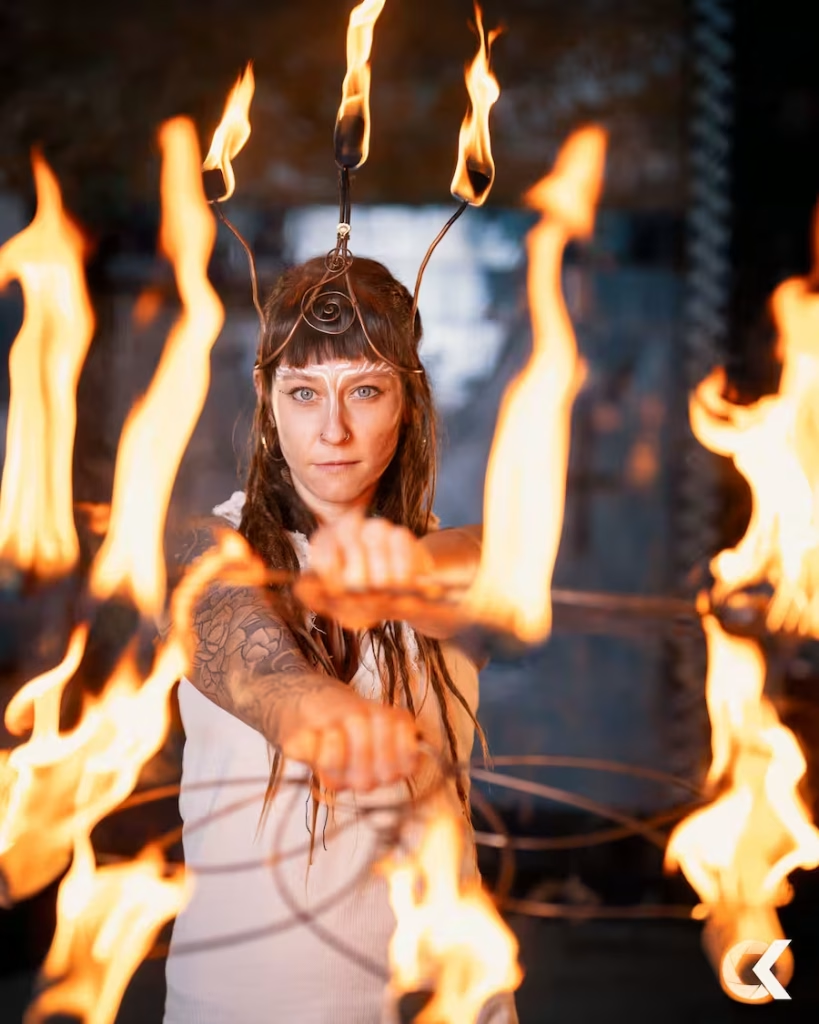
Flow Arts
You experience it as ART because you make it so. Through this medium, you shape expression with the intention to grow, to unfold, to evolve, and to find joy in the journey of learning.
And when a companion, a mentor, a teacher walks beside you, it may awaken what in art therapy is called the ‘unknown third,’ and in that meeting, something sacred stirs. That’s when it becomes magic.
With a reflective mindset and the willingness to stay with it, people may come to experience this magic for themselves through this ONE medium alone. The engagement with it can feel like a form of therapy. A relationship begins to form, and once it has you, you may not want to let it go, or at least, not let it slip too easily from your arm and life.
It can accompany you on your journey, walk with you on your path, and give you the courage to be seen or at least find different possibilities for how to move on.
You don’t just hold it, and it doesn’t merely drift across your skin. It becomes something more. Through Flow Art, with your prop, the ONE you burn for, the ONE that excites you, you almost forget everything around you. Because in that moment, it’s just you, the NOW, and the MOVEMENT, united as ONE into FLOW. And the art becomes the outward expression of your passion.
Your mind connects through this play and the flow, forgetting space and time. Spinning, breaks, pedals, on-body, off-body, contact, all of it. Everything that once seemed important from the outside fades away the moment you begin the dance of Flow Art.
It offers you a way inward, a chance to escape the noise of the outside world.
And maybe, just maybe, it gives you a glimpse into your inner world, helping you understand how you respond to the outer one.
FLOW is a distinct psychological state of optimal experience, first conceptualized and named by psychologist Mihály Csíkszentmihályi in the 1970s. It is characterized by complete absorption in an activity, intense focus, a merging of action and awareness, diminished self-consciousness, a distorted sense of time, and an experience of intrinsic reward. Flow typically emerges when there is a balance between the perceived challenges of a task and the individual’s skill level, resulting in deep engagement, increased performance, and enhanced creativity.
Flow Arts is much more than most people assume.
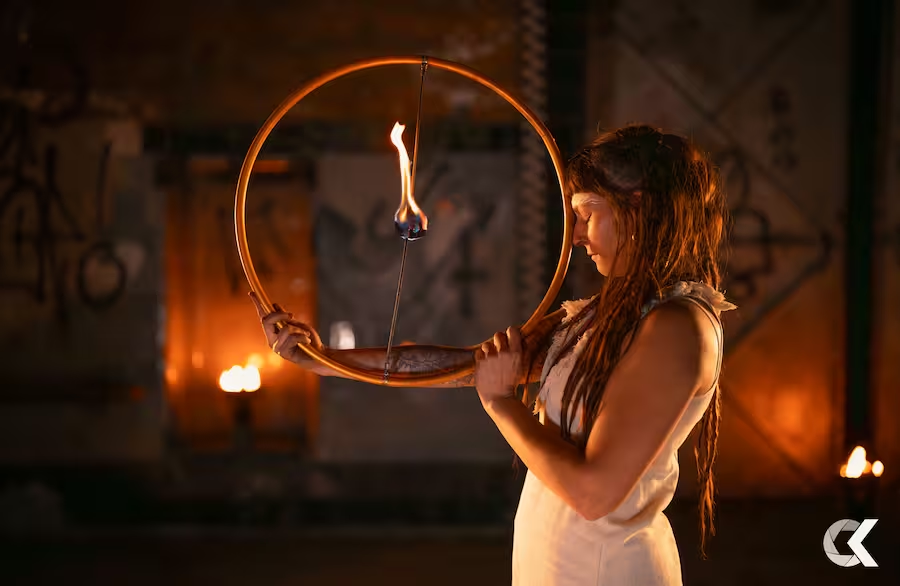
It always carries within it an element of learning and of being seen.
Like many things we encounter for the first time in life, it invites us to show up for ourselves, again and again.
And then, one more try and another, until suddenly, we get it, and it flows.
It can be compared to a journey, to learning a new language or instrument,
or even to being kissed by the muse, transforming movement into pure artistic expression.
It starts with the courage to try something new.
Even at that point, it can be a moment of inner struggle for some people.
Do I want to open up a moment for play?
Maybe play like a child, with a stick (staff), a plastic tube circle (hoop), juggling clubs, or balls on a string (poi), whether being seen or unseen.
Can I handle it when I show up in the moment and maybe fail in front of others?
Maybe you get introduced to a prop by a friend, or you see someone dancing, playing, and enjoying the moment with it, and you get drawn in, wanting to find out more. Conversations begin, and through that, connections between people start to grow.
What I experienced was getting to know one of my long-term best friends, Anna, through a hula hoop, over 15 years ago. Especially in the beginning, our friendship was nurtured and strengthened through Flowart. We learned from each other, had plenty of moments of failing together, taught each other new tricks while having fun, and through that, a much deeper friendship grew.
Even now, she still feels like a teacher and mentor in my life, inspiring me in many ways to flow more freely with life. And for this connection, I’m still deeply grateful, not only for becoming a better hoop dancer, but for growing into a stronger and more authentic woman.
And so my journey began, a lifelong connection to a prop like a hula hoop, fans, or poi.
There is so much more to discover in the world of Flowart.
For some, it might just be a plastic tube, two balls on a string, or something you throw into the air.
But if your mind is open enough to catch that magical moment, and you choose to follow that spark of curiosity and enthusiasm,
then maybe it becomes something more than just a toy.
Maybe you choose to remember life through Flowart,
or simply to feel more alive in a single moment,
because it can show you a whole new perspective:
a different connection to yourself, to your inner world,
and to how you show up for others and the world around you.
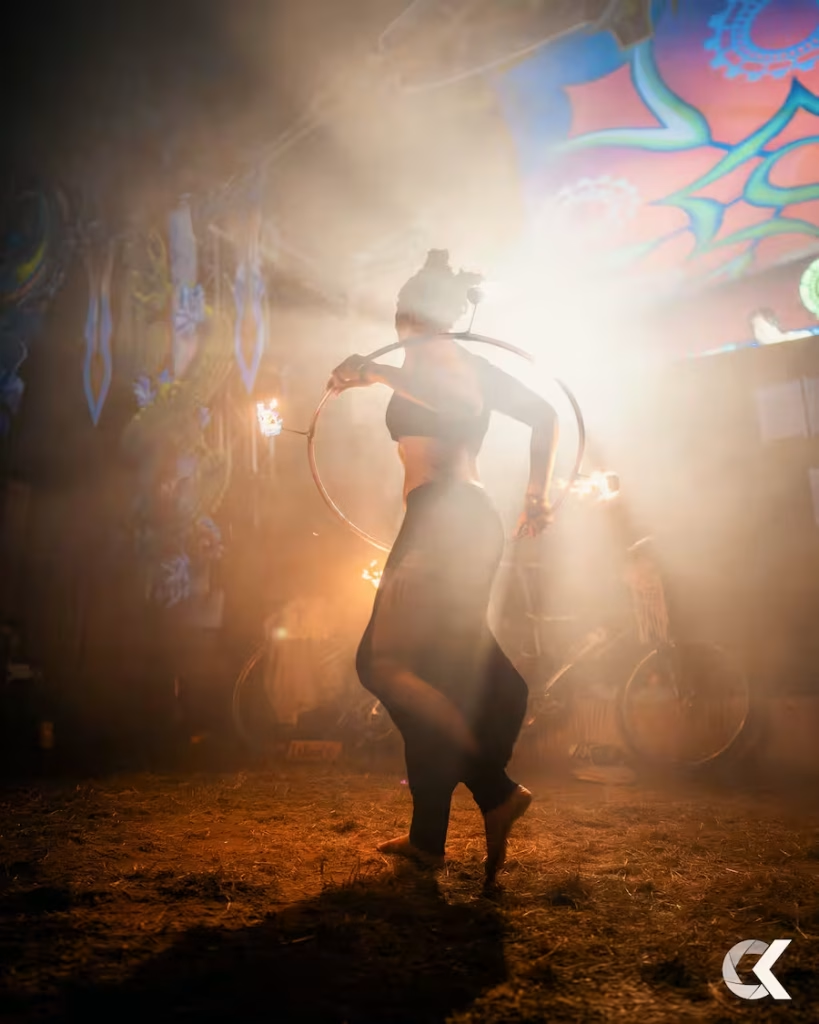
It mirrors how you take usual things in life. Can you celebrate and be happy for your fails, wins, and learnings in life? Can you be proud of yourself, what you have learned, and how far you have come? How do you deal with performing in front of other people? Is it possible, at one point, to enjoy showing yourself to the outside? How do you deal with fails during training or mistakes? Flowart can teach people to deal better with fails, smile about them, and just move on. Do you get angry, pissed off, and want to smash your plans into another universe when you make a mistake? Can you forgive yourself when you need more time to get things done and see it as “next time I can make it better”? Or do you find peace after a little break and then try again?
All of these questions, in my world, seem to pass through different layers across many areas throughout life, Flowart (which is just a slightly bigger part of mine that helps make things clearer), as well as relationships, school, work, learning a language, or an instrument. It is about how we receive, react, deal, act, learn, and flow throughout the entire process.
If you decide to jump on the train to get a prop of Flowart in your hand, or maybe even own one, it can make a difference in your whole process of experiencing the world.
While you play, and before it turns into real play and flow, we are talking about trust in the unknown process and future at every moment as you play, perhaps seeing the world again with open-minded eyes, like a child, open to experience.
Maybe you fail, maybe you get it, maybe you will hurt yourself, and maybe you will enjoy simply being in the process, in the moment, in the unknown, not knowing what’s going to happen.
One of the most beautiful things about flow arts and the global community of “freaks with flowtoys or fire props” is the opportunity to connect with them at festivals, retreats, conventions, and fire-spinning gatherings around the world.
But it’s not just about that. When I received an invitation from one of my most passionate fire circus friends, Kinich Balam Ahau from Mexico, to attend the Psycristrance Festival in San Cristóbal, I knew it was a great opportunity to dive deeper into performing with fire at festivals, even though at that time, I still felt shy. That experience turned out to be a true kickstart, a turning point that made me realize: my journey as a fire performer is something I truly want to begin.
I’m especially grateful for the connection with Kinich, who performs not only in Mexico. This guy leaves me speechless with his dedication and passion. He brings flow freaks together to co-create shows and travels, often by public transportation, carrying a lot of gear just to bring smiles to people’s faces and inspire them with mesmerizing performances. His commitment to sharing the magic of fire and flow is deeply inspiring. You can check out more about him by searching for Psylocibe Lunar Cirko, or maybe you’ll catch him performing at a psytrance festival somewhere in Europe this summer.
My most beautiful experience of learning more about flow arts so far was in Guatemala, at the GuateFlowArt Retreat, where I had the chance to learn from world-class teachers and performers like Vojta Stolbenko, Chaskasiri, Gollita, and others, all in an absolutely stunning location at Lake Atitlán, surrounded by breathtaking natural beauty.
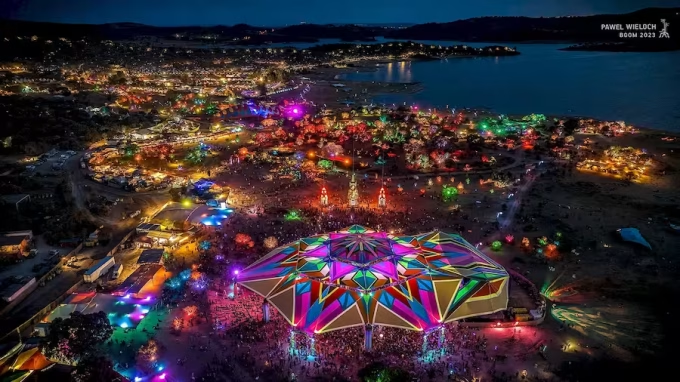
The most powerful fire-spinning festival I’ve ever attended was in the Czech Republic, a festival called Roztok. It brings together the best of the best artists in flow arts, circus, and fire performance. The festival features a fantastic variety of live bands and DJs playing on different stages and areas around the festival grounds.
During the day, you can join workshops led by these amazing artists, who openly share their knowledge, skills, and love for the art. Every day is packed with workshops focused on specific props and techniques, taught by professional performers. In the evenings, you have the opportunity to see these artists on stage with their incredible performances, either in the big circus tent or at the dedicated fire space.
And after the shows, the night is far from over. It’s time to jam, burn, and play together with the other freaks and friends.
Flow arts alone have become something deeply meaningful to me, but combining them with the element of fire has taken the experience to a whole new level.
One more unspoken love I have for flow arts and fire performance is the constant opportunity to learn from one another. Even if you don’t speak the same language, it doesn’t matter, because the language of movement, rhythm, and play speaks for itself.
For example, jugglers often love to pass clubs back and forth, and they’re usually happy to share a round, even with beginners. I believe flow is like that: open, inviting, and shared.
So keep your eyes open for flow art freaks and take the courage to talk to them. It might lead to an interesting conversation, and maybe even a spontaneous flow experience.
Teaching or learning a new trick with a flow toy, breaking it down slowly or relearning it with someone else, is a deeply embodied process. It helps you program and reprogram your awareness, refining your understanding of what’s happening in and around your body, your brain, and the toy.
Scientific studies have shown that playing with flow toys, such as poi, double staff, and other object manipulation tools, supports the integration and coordination of both hemispheres of the brain. This is because flow arts involve complex, symmetrical and asymmetrical movement patterns that require cross-lateral coordination, spatial awareness, rhythm, and timing. These activities not only enhance physical dexterity but also stimulate neural pathways that improve cognitive functions such as focus, memory, and creativity. In fact, research involving poi spinning has demonstrated improvements in coordination, working memory, and even emotional regulation. Practicing flow arts is more than just fun. It’s a powerful tool for holistic brain-body development that combines mindfulness, movement, and play.
Even with just one flow toy, it’s possible and often necessary to switch hands or change directions. This process can really challenge the brain at first, sometimes making it feel completely overwhelmed until the mind finally understands the correct movement in just the right moment. But what “the right movement” is can shift over time, because eventually the brain, the body, and the object, the medium, begin to connect and move as one. That’s when flow begins. The mind no longer needs to consciously control what’s happening; instead, intuition takes over. Movement flows naturally, guided by rhythm, presence, and the interaction between your body, the toy, and the music.
Flow arts offer so much more than just movement. They are a journey through self-development, discipline, and joy. They train both body and mind, while also teaching us patience, presence, and play. Whether illuminated by colorful LED lights or fueled by the raw energy of fire, flow invites us to live with passion and purpose. It reminds us to stay focused, to get back up after setbacks, like a skin burn or a missed move, and to trust that we can learn, adapt, and grow.
Flow keeps us moving forward, and teaches us to turn with a smile, even in the middle of life’s chaos. Because life itself can feel like a flow when we open ourselves to both giving and receiving. And when movement and timing align, we become dancers.
Dancers of flow arts. Dancers of timing and movement. Dancers with fire. Dancers with friends and good music, all over the world, ready to be fully present in the moment, both for themselves and for others, keeping everyone grounded, inspired and fascinated in the NOW.
And what is dance, if not art and connection in motion?